Job Sharing: From Niche Practice to Workforce Strategy
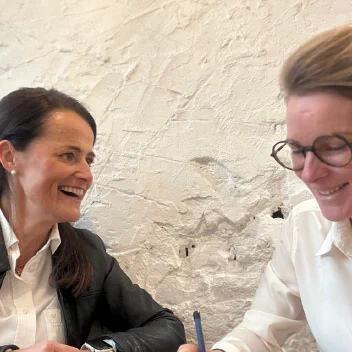
Nathalie de Wachter
Job Share Advocate
My job sharing / In a job-share partnership with Marie-Christine.
“I believe, however, that the conditions for a breakthrough have never been stronger.”
When discussing flexible work, Belgium is often seen as a mature market. Part-time work is widely accepted and deeply embedded in our employment culture. Yet there is an important nuance: Belgian part-time work is predominantly organised as a four-fifths arrangement (80%).
As a result, job sharing remains surprisingly unknown. Many employees, managers and even HR professionals have never encountered it in practice. The concept is often misunderstood or confused with traditional part-time work. The biggest obstacle is therefore not resistance, but a perception gap. People tend to support the idea once they understand how it works, but many have simply never seen it in action.
This is perhaps what differentiates Belgium from countries such as Switzerland and Germany. While job sharing has gained visibility and credibility there, Belgium is still heavily influenced by established habits and traditional organisational models. Organisations often continue to structure roles around one person, one position, one career path, despite profound changes in society and the labour market.
I believe, however, that the conditions for a breakthrough have never been stronger. The world of work is changing rapidly. Careers are becoming longer and less linear. Organisations are facing talent shortages, demographic shifts, increasing numbers of long-term illnesses, growing demands for work-life balance and, at the same time, the impact of digitalisation and AI. New working models are needed.
Job sharing offers a practical and proven solution. Thanks to modern communication and collaboration tools, two professionals can coordinate seamlessly, ensuring continuity, resilience and knowledge sharing. What may have been difficult to manage twenty years ago is now remarkably straightforward. Moreover, pilot projects consistently generate positive feedback. Organisations discover improved continuity, broader expertise, more creativity and faster decisions, stronger resilience and higher employee engagement. The evidence coming from Germany and Switzerland shows that job sharing can work successfully not only in expert roles but also in leadership positions.
„The concept is straightforward and the impact is powerful.“Nathalie
On a personal level, my interest in job sharing comes from direct experience. I have had the privilege of practising it together with my job-share partner, Marie-Christine. What fascinates me most is its simplicity and its power. The concept is straightforward and the impact is powerful. Two professionals bring complementary perspectives, challenge each other’s assumptions and learn continuously from one another. Decisions are often better informed, knowledge is shared naturally and the feeling of professional isolation disappears. At the same time, both partners gain flexibility without sacrificing meaningful responsibilities or career ambitions.
Perhaps most importantly, job sharing creates opportunities for people who might otherwise leave the workforce or step back from leadership roles. It can support parents, caregivers, people returning after illness and experienced professionals who wish to remain active while reducing their workload. For me, job sharing is not merely a flexible work arrangement. It is a way of making work more sustainable, more inclusive and, ultimately, more human.
The scale-up of job sharing is not a question of „if“ but of „when“. And from my perspective, that moment is now. As organisations search for innovative ways to attract, retain and support talent, job sharing deserves a place much closer to the mainstream of workforce strategy.